The real difference between people who learn fast vs. those who don't
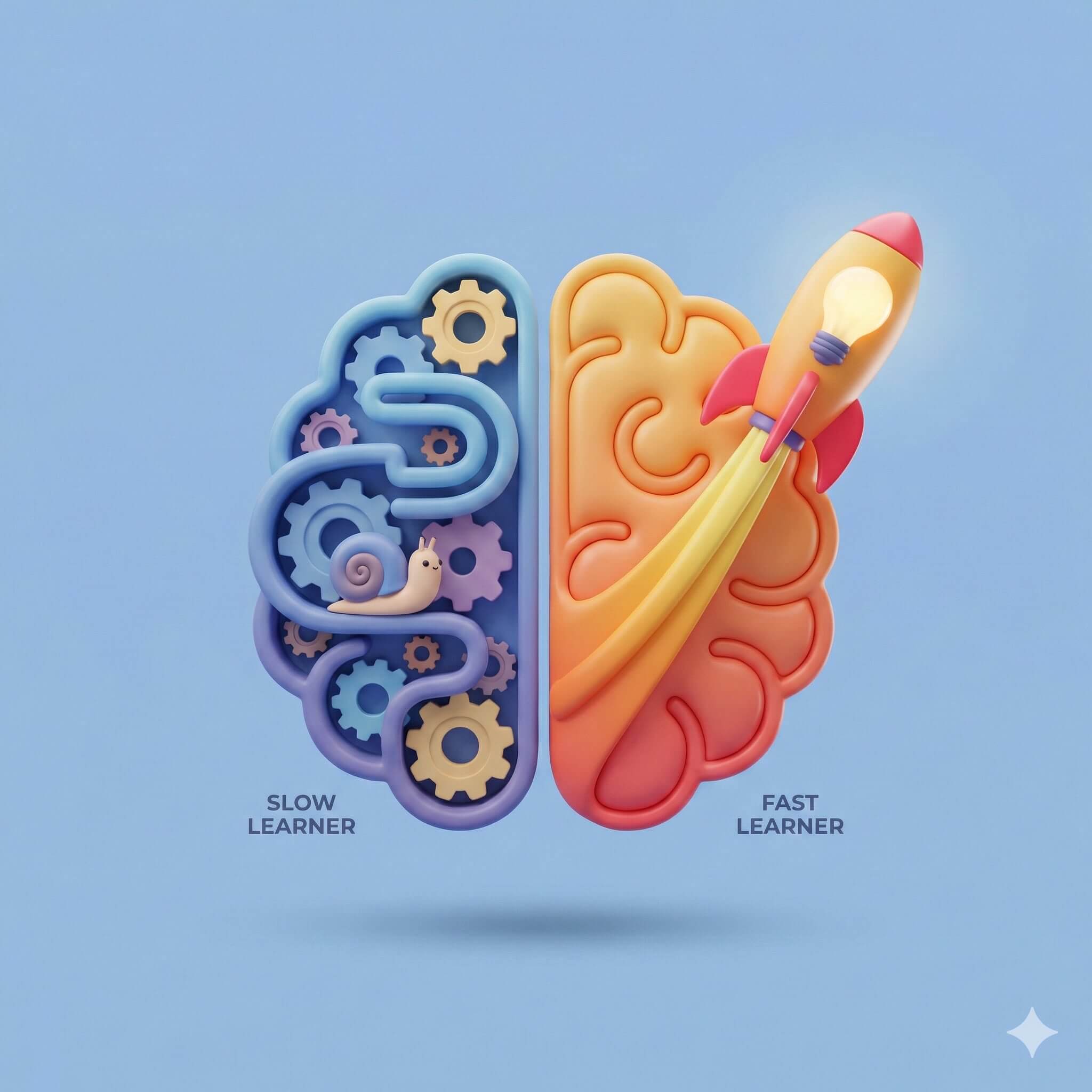
Some people learn in months what others take years to understand.
I used to think it was talent. Then I thought it was discipline. Then I spent enough time watching smart people struggle with new skills and realized: it’s neither.
It’s architecture. 🏗️
The assumption that’s quietly slowing you down
Most people believe learning speed comes down to three things: how smart you are, how motivated you feel, and how many hours you put in.
I don’t buy it.
I’ve watched two people spend identical hours on the same material. One improves five times faster. The difference isn’t effort. It’s the system they’re running underneath the effort.
Intelligence is the hardware. Method is the operating system. And most people are running a very outdated OS.
The three levers I keep seeing in fast learners
1. Compression thinking 🧠
Fast learners don’t collect information. They compress it.
Instead of memorizing ten rules, they find the one principle that explains all ten. Instead of taking more notes, they ask: what’s the smallest idea that contains all of this?
Slow learners accumulate facts. Fast learners extract patterns. That’s not a small distinction. It’s the whole game.
The model:
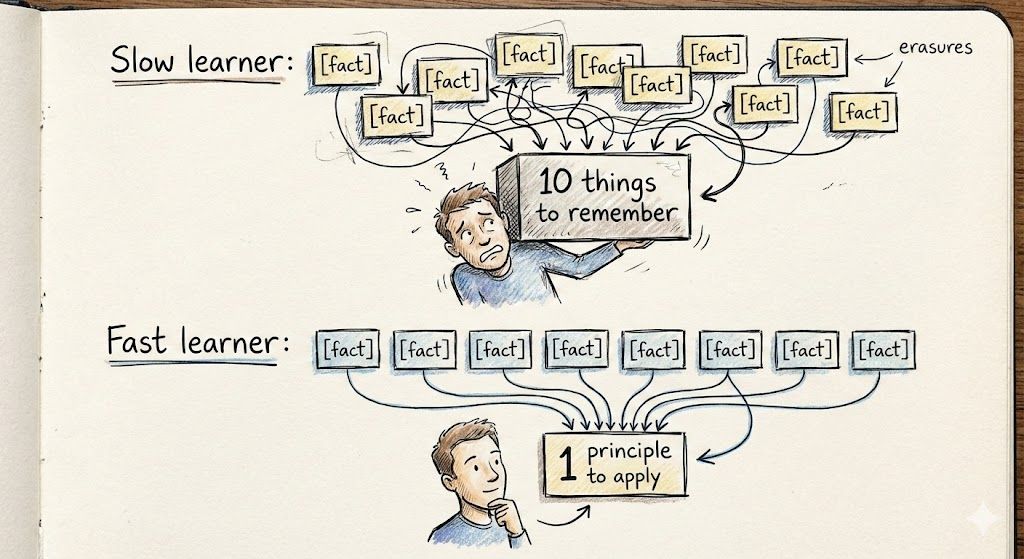
The compression ratio is the skill. The better you get at it, the faster everything else becomes.
2. Output-driven learning 🔁
Most people learn like this: consume → consume → consume → panic → produce.
The fastest learners I know flip it entirely: try → fail → refine → repeat.
They don’t treat output as proof of mastery. They treat it as the engine of understanding. You don’t fully know something until you’ve broken it trying to use it. The trying is where the learning lives.
The model:
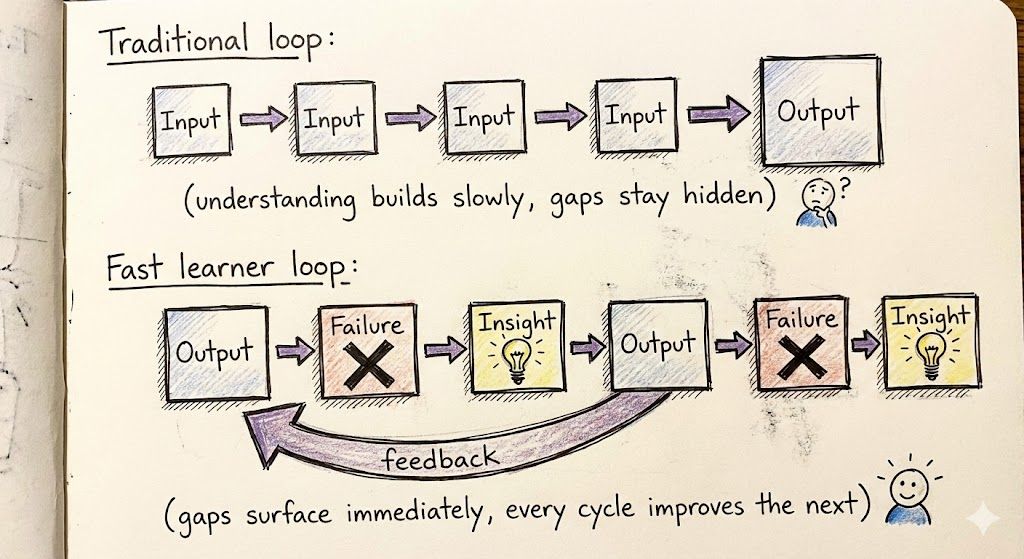
The feedback loop is tighter. That’s why the curve is steeper.
3. Friction design ⚙️
Here’s the counterintuitive one: average learners try to remove difficulty. Fast learners deliberately add constraints.
Time limits. Teaching out loud. Practicing without notes. Explaining a concept to someone who has no context.
These aren’t study hacks. They’re diagnostic tools. Constraints expose gaps in understanding that comfort keeps hidden. Difficulty isn’t the enemy of learning. It’s the mechanism.
The model:
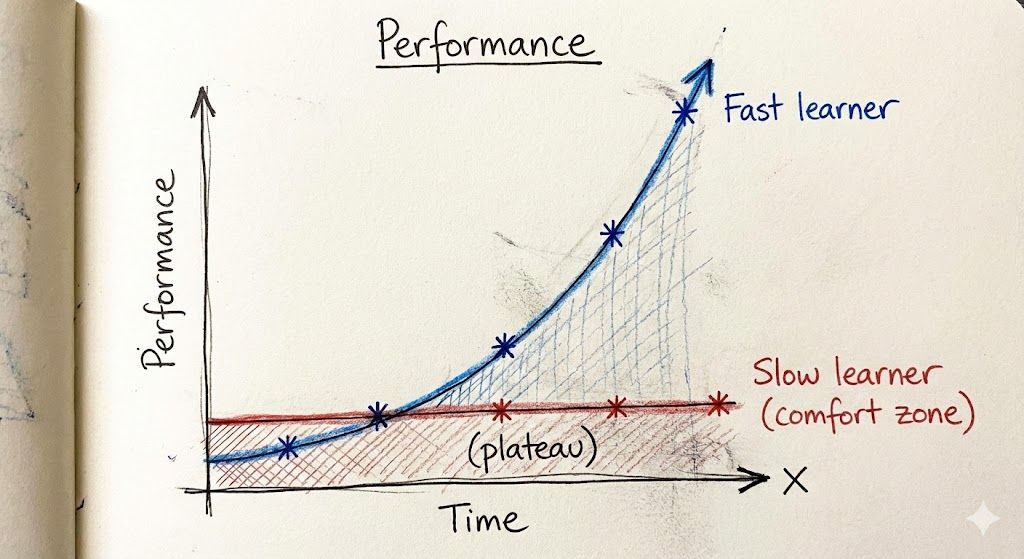
The fast learner curve looks harder early on. It is. That’s the point. Productive struggle isn’t inefficiency. It’s investment.
The 60-second test I use on myself ⏱️
I have one rule I keep returning to:
If I can’t explain something in 60 seconds without notes, I don’t understand it yet.
Not “I haven’t revised enough.” Not “I need to review.” I simply don’t understand it.
This test is brutal in the best way. It replaces the illusion of competence (that comfortable feeling of having read something) with actual clarity. Most people mistake familiarity for understanding. This test makes sure I don’t.
Why most institutions don’t teach any of this
Because it doesn’t scale.
Most learning systems are designed to measure understanding, not accelerate it. They optimize for evaluation, grading, and completion. Memorization is easier to test than compression. Coverage is easier to track than clarity.
So that’s what gets rewarded. Structured recall over genuine understanding. Breadth over depth. Output on command over output that actually sticks.
It’s not malicious. It’s just what happens when you optimize a system for throughput instead of transformation.
What this actually means for how you learn
Fast learners aren’t faster because they think quicker. They’re faster because they’ve built a better feedback loop.
They compress instead of collect. They produce before they’re ready. They use constraints as tools instead of treating them as obstacles.
The system they run is different, and that changes everything downstream.
That’s the principle I keep coming back to in my own learning, in the workshops I run, and in how I think about building skills that actually transfer. It’s not about working harder inside a broken process.
It’s about redesigning the process entirely. 🎯
If this resonated, I’d love to know: what’s one learning method you’ve tested that actually worked?
Written by Amit Srivatsa
Marketing Strategist & AI Consultant